Giemme di MOLA SRL
The story
This is the story of the Giemme company in Mola from 1974 to today, two generations of inventors and innovators in the poultry farming sector.
The story
Giemme di Mola from 1974 to today
1974
In 1974, Mr. Giuseppe Mola began manufacturing conveyor belts for transporting poultry from inside the farms to the outside, where workers manually placed the birds into cages. These were the first steps in a new frontier of finding a solution for manual harvesting, moving toward automation.
1975
The following year, 1975, Mr. Giuseppe Mola founded the MF Company where he continued the production and sale of chicken transport belts.
1976
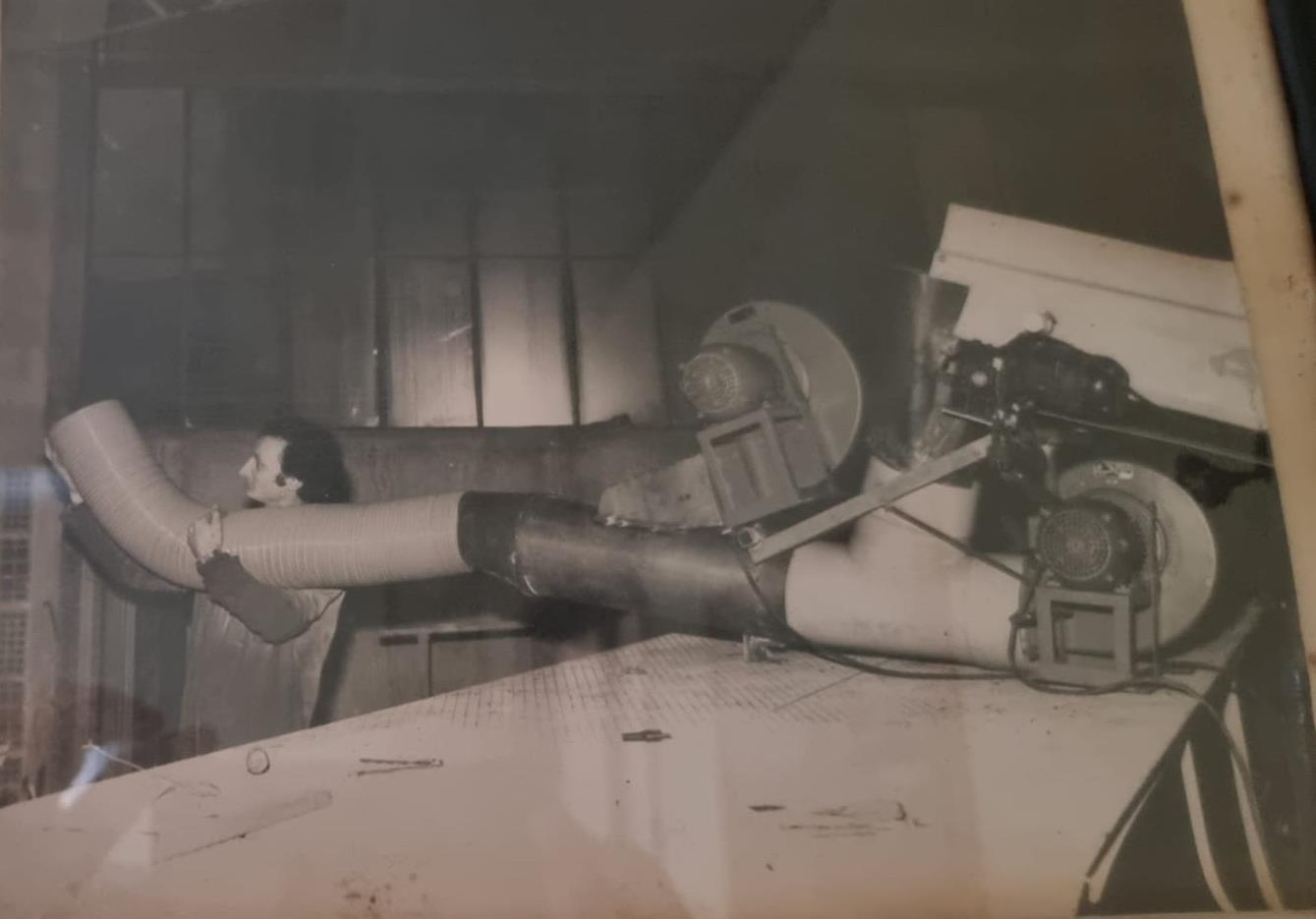
In 1976, Mr. Giuseppe Mola studied and invented an innovative system for placing chickens directly into cages. At the time, cages were made of wood or plastic, with small doors, making it very difficult to find a practical solution to the loading problems.
Using its transfer belts, the birds were moved and unloaded into a funnel. Two fans then pushed the birds into a tube with airflow, and the operator placed them into cages through this tube.
This is the first patent prototype for the current automatic loading machine.
1979 - 1984
In recent years, while continuing to produce conveyor belts and other agricultural machinery, Mr. Giuseppe Mola began to develop his idea for a system for harvesting chickens on the farm, using not only operators but also automated solutions. He developed several automated machines with different solutions for harvesting chickens directly on the farms. No other competitor wanted to pursue this idea, especially since at that time, in the 1980s, the technological solutions were certainly not up to par. Mr. Mola was the only one capable of continuing and improving these machines.
The first solutions today seem very easy and simple, but these are the “foundation stone” for today’s self-loading machines.
This model was the first real automatic harvesting machine in history.

As it advanced, the machine collected the chickens directly from the ground using a “comb” which, without harming the animals, moved them close to the collection tray.
Once the required amount was collected, the tray was turned over and the chickens were funneled to the bottom of the tray.
Once the chickens were collected, the belt at the end of the tray moved the chickens onto the farm’s conveyor belts.

1980 – The “comb” machine.
The following year, 1981, Giemme presented a new solution with improved performance, making it possible to further reduce chicken harvesting times, developing a model that allowed the birds to be harvested with a rear conveyor that was no longer fixed in a single position, but could instead follow the movement of the machine and continuously unload the chickens onto the belts to take them out of the shed.
The front comb has been replaced with two rotating cylinders with rubber fingers.
This combined system, cylinders with rubber fingers on the front and a no longer fixed rear belt, in addition to reducing harvesting time, caused less damage to the animals.

1981 – The “finger” machine.
Year after year, Mr. Mola works to improve and make the machines more reliable to avoid downtime during loading.
Animal welfare was also one of Giemme’s priorities, and for this reason Mola continues to develop new solutions.
With the entry of Mr. Enrico Mola into the company, a “new generation machine” is launched.
It’s 1984, and the Giemme company begins to rewrite the new rules for animal collection.
Until now, harvesting machines have only moved a small group of chickens at a time, making loading a rather lengthy and complex process. Furthermore, the cages remained outside the farm, and the actual loading into the cages was still done manually.
Mola father and son created a new harvesting concept: no longer a “static” load, but a complex mobile machine with an oscillating arm to collect all the birds on the farm in a single pass.
At the front of the swing arm, a fan gently pushes the birds onto the main conveyor belt, and they are moved until the machine returns. At this point, large numbers of birds are ready to be placed in cages.


1984 – The “fan” machine.
1984 - 1995
A new collaboration begins with the Cattaruzzi company, sharing the new BTG Group harvesting head, whose patent Cattaruzzi was able to exploit, and the reliable Giemme machine.
This joint venture allows the Mola machine to also be introduced into the US market.
The BTG Group’s capture warhead consisted of three rotating finger cylinders used to capture birds from the machine’s swinging arm.


This machine is from 1985, installed in Italy and still working.
The machine has been equipped with a rear tray where the birds arrive and the operator places them into the cages moved within the farm by tractors.
Meanwhile, the Mola company develops a new system to have the front head interchangeable with its new solution.

Two important issues still remain when using the machine: the damage caused by the front head on the birds, and also the loading and handling of the cages.
Cages can only be loaded through one door, one bird at a time.
For this reason, Giemme is starting again with a new and revolutionary concept for loading birds into cages.
They make a large “basket” to collect the birds that arrive from the machine without having to insert one chicken at a time.
This is the first live bird container


In recent years, while continuing to produce conveyor belts and other agricultural machinery, Mr. Giuseppe Mola began to develop his idea for a system for harvesting chickens on the farm, using not only operators but also automated solutions. He developed several automated machines with different solutions for harvesting chickens directly on the farms. No other competitor wanted to pursue this idea, especially since at that time, in the 1980s, the technological solutions were certainly not up to par. Mr. Mola was the only one capable of continuing and improving these machines.
The first solutions today seem very easy and simple, but these are the “foundation stone” for today’s self-loading machines.
This model was the first real automatic harvesting machine in history.
1996-2000
Here Mr. Enrico presents the new belt loading head and also the new trolley for drawer containers.
The machine was redesigned to be loaded onto the truck with the trailer as well.

With this new solution, Mr. Enrico avoids the problem of damage caused by heads with rubber fingers, further improving loading times.
The machine was driven by an operator at the front, who moved the arm and moved the machine forward. The system was an excellent solution at the time, because litters were usually very wet and covered in lumps.
With this front head mounted on the machine, the load can follow the floor and catch all the birds without any damage.
Mr. Enrico also started a new production line of machines to process litters, and obtain a more hygienic place for the birds.
2000-2005
The Giemme company was contacted by an American company, Lewis, and they began a collaboration, transferring the automatic loading machine directly to the USA, to reduce sea freight costs and also delivery times.
The collaboration with Lewis brought Giemme into contact with the University of the United States and Mr Enrico machine was also published in the specialized magazine.


With Company Lewis, Giemme increases its experience in the US market.
Unfortunately, Lewis’s owner died in 2005 and the business closed.
2005- Today
Between 2005 and 2010, breeders realized that having a better litter meant having healthier animals. So the litter boxes became flatter, and Mr. Enrico was able to begin marketing his latest machine, designed and patented in 2000.
The AURORA model becomes the benchmark in the collection sector, a fully automatic, self-propelled machine, with a single operator to load the containers.

GIEMME, THE BEST LOADING EXPERIENCE
Road test
If you are interested, you can request a test drive at our customers' premises to see for yourself the work our machines are capable of doing.
Fill out the form below and one of our representatives will contact you to arrange a meeting at one of our clients.